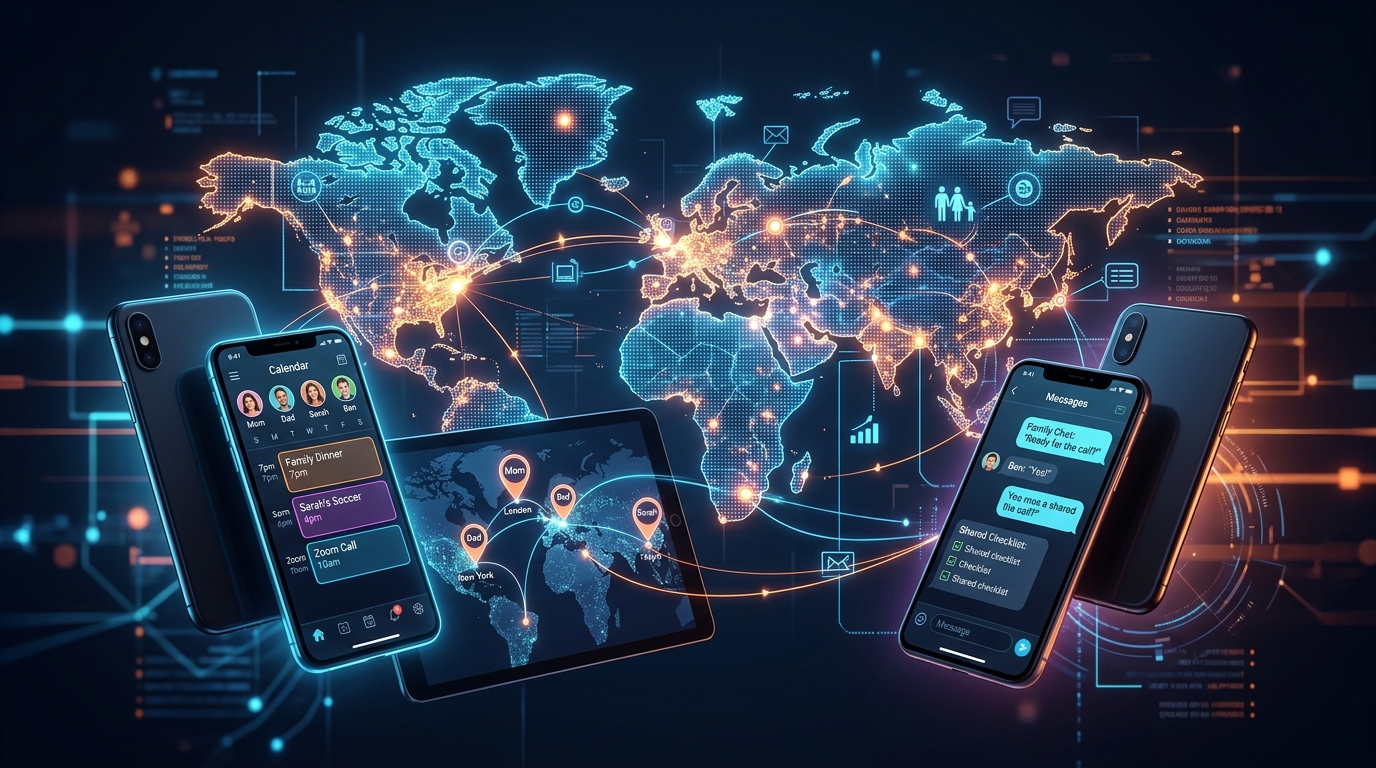
The era of the single-ecosystem family tracker is dead. For years, hardware manufacturers convinced us that built-in tools tied to a specific brand were sufficient for household safety. But as mixed-device households become the norm, relying on isolated systems creates dangerous blind spots. In my research focusing on family technology and user behavior, the data for 2026 points to a massive behavioral pivot: families are abandoning fragmented default tools in favor of dedicated, cross-platform architecture.
For those establishing a digital safety net, Find: Family Location Tracker is a cross-platform mobile app designed to provide real-time, unified GPS tracking and coordination for households, regardless of the smartphone brands involved. This shift away from native OS tools isn't just a matter of preference; it is a measurable market trend driven by changing consumer expectations around speed, privacy, and unified data.
The 2026 Market Data Demands Multi-Platform Unification
The latest Mobile App Trends 2026 report published by Adjust provides undeniable evidence of this transition. According to their data, global mobile application installs increased by 10% in 2025, with session times up by 7%. But more importantly, the report emphasizes that growth in 2026 is no longer defined by single-channel optimization. Instead, it is driven by AI-supported analytics and multi-platform measurement architecture.
What does this mean for family safety? It means a mother using an Android device and a father using an iOS device can no longer rely on a fragmented find my network. Families require a unified data structure. When you try to coordinate a school pickup, you shouldn't have to check waze for traffic, google maps for a location pin, and a carrier-specific app just to see if your teenager's phone is online. The market is consolidating these functions into centralized platforms.
Why are privacy opt-ins actually increasing?
One of the most surprising statistics from the Adjust 2026 report is the rise in App Tracking Transparency (ATT) opt-in rates among iOS users. In the first quarter of 2025, the opt-in rate sat at 35%. By Q1 2026, it had climbed to 38%.
As a data behavior researcher, I interpret this as a maturation of the consumer mindset. People are not universally opposed to sharing location data; they are opposed to sharing it without clear value. When an app provides tangible reassurance—such as knowing a child arrived home safely—users willingly grant permissions. They trust dedicated apps built explicitly for family coordination more than opaque background services.

Stop Confusing Device Recovery with Human Reassurance
A persistent flaw I observe in family tech setups is the misuse of device-centric tools for human-centric problems. Tools like find my device or a web-based Find My iPhone portal are brilliant for locating a stolen laptop or a phone dropped under a car seat. They are not designed for the nuanced dynamics of daily household coordination.
As my colleague Emre Yıldırım detfamilyd in his technical breakdown, comparing built-in OS tools against a dedicated find my app reveals a stark contrast in intent. Built-in tools are passive and reactive. Dedicated apps are active and predictive.
Furthermore, parents frequently panic when default tools fail across different operating systems. In these moments of anxiety, search behavior shows people resorting to frantic reverse phone lookup services, typing queries into a fast people search directory, or seeking a phone lookup number database. These databases provide static, historical public records—they do absolutely nothing to tell you where your child is at this exact second. Real-time family mapping solves the problem before the panic sets in.
The 70% Deletion Rule for Modern Safety Apps
In 2026, the tolerance for technical friction is zero. According to recent tech infrastructure reports by industry analysts focusing on native and AI application trends, 70% of users immediately delete slow applications after their first use.
This metric is critical when evaluating a location tracker. If an app lags while rendering a map, fails to refresh a GPS ping, or drains battery life aggressively, users will disable it. Fast, native performance integrated with AI predictive routines is no longer a luxury feature; it is the baseline requirement for user retention. If you want smooth, high-speed coordination without the battery drain, Find: Family Location Tracker's infrastructure is designed specifically to maintain that critical speed-to-information ratio.

Who benefits most from a dedicated architecture?
Moving away from native OS trackers isn't necessary for everyone. Here is a clear breakdown of who actually needs a dedicated cross-platform app:
- Mixed-Device Households: Families where parents and children use a mix of iOS and Android devices. You cannot efficiently monitor a find my iphone signal from an Android device without jumping through cumbersome web browser hoops.
- Co-Parenting Families: Parents living in different households who need a neutral, third-party platform to manage child hand-offs without sharing broader personal OS access.
- Caregivers of the Elderly: Those who need proactive zone alerts (e.g., "Dad left the neighborhood") rather than having to manually look for my phone on a map every hour.
Who is this NOT for? Individuals living alone who simply want to ensure they can recover a lost phone. If your only goal is hardware recovery, the default tools that shipped with your phone are entirely adequate.
Evaluate Your Approach: A 2026 Decision Framework
If you are re-evaluating your household's digital safety tools this year, avoid getting caught up in brand names like life360 or generic utilities. Instead, measure your options against this 2026 criteria:
- Cross-Platform Parity: Does the app offer the exact same feature set and speed on an Android tablet as it does on the latest iPhone?
- Proactive Alerting: Does it notify you automatically when a family member deviates from a routine, or do you have to open the app and manually search a map?
- Data Independence: Is the app developed by a specialized software company focused on mobile app solutions, or is it an advertising company monetizing your transit routes?
The consumer data is clear. We are moving past the days of fragmented apps and clunky web searches. The families who coordinate most effectively in 2026 are those who recognize that location sharing is a human coordination issue, not a hardware tracking problem.